
Your iPhone battery replacement can take 20 to 45 minutes on the bench, but the total wait can stretch from a few hours in a workshop to 5 to 7 business days for mail-in service, and even longer when appointment queues build up. If you're staring at a phone that won't hold charge through the day, the primary question isn't just how fast the swap is, it's which service path will get you back to normal with the least hassle.
Table of Contents
- Understanding Your iPhone Battery Replacement Time
- The Core Repair Time What Happens on the Bench
- Comparing Turnaround Times Workshop vs Mail-In vs Apple
- A Step-by-Step Look at the Mail-In Process
- What Factors Can Delay Your Battery Replacement
- Getting Your iPhone Battery Replaced Without the Hassle
Understanding Your iPhone Battery Replacement Time
If your iPhone is draining before the day is half over, the question is no longer whether the battery is getting weak, it is how long you will be without the phone. The repair itself is usually straightforward, but the total wait depends on how the device gets to the technician, how much checking is needed, and whether the right parts are already on hand.
Apple says an iPhone battery is designed to hold up under normal use for a long service life, and that battery health should be judged by condition rather than by guesswork Apple battery guidance. That matters because two phones can behave very differently. One may still feel fine, while another is already shutting down, dropping charge fast, or showing other signs that the cell is near the end of its useful life.
A battery replacement is rarely delayed by the swap alone. The main difference for customers is the journey around the repair. A local workshop can feel quick because the handover is direct, a booked Apple Store visit can still involve waiting around the appointment, and a mail-in option adds transport time before anyone even opens the phone.
If you are trying to judge whether the battery is the problem, the clearest first step is to check the symptoms. This guide on how to know when your iPhone needs a battery replacement is a useful place to start, especially if the phone is charging oddly, switching off early, or showing signs that do not match normal daily use.
For iphone battery replacement how long, the practical answer is that the bench work is only one part of the total. The rest comes down to diagnostics, booking, packing, postage, and collection. That is why Repair My Crack treats timing as part of the service, not just the repair itself, so customers know what to expect before they hand the phone over.
The Core Repair Time What Happens on the Bench
Why the actual swap is usually quick
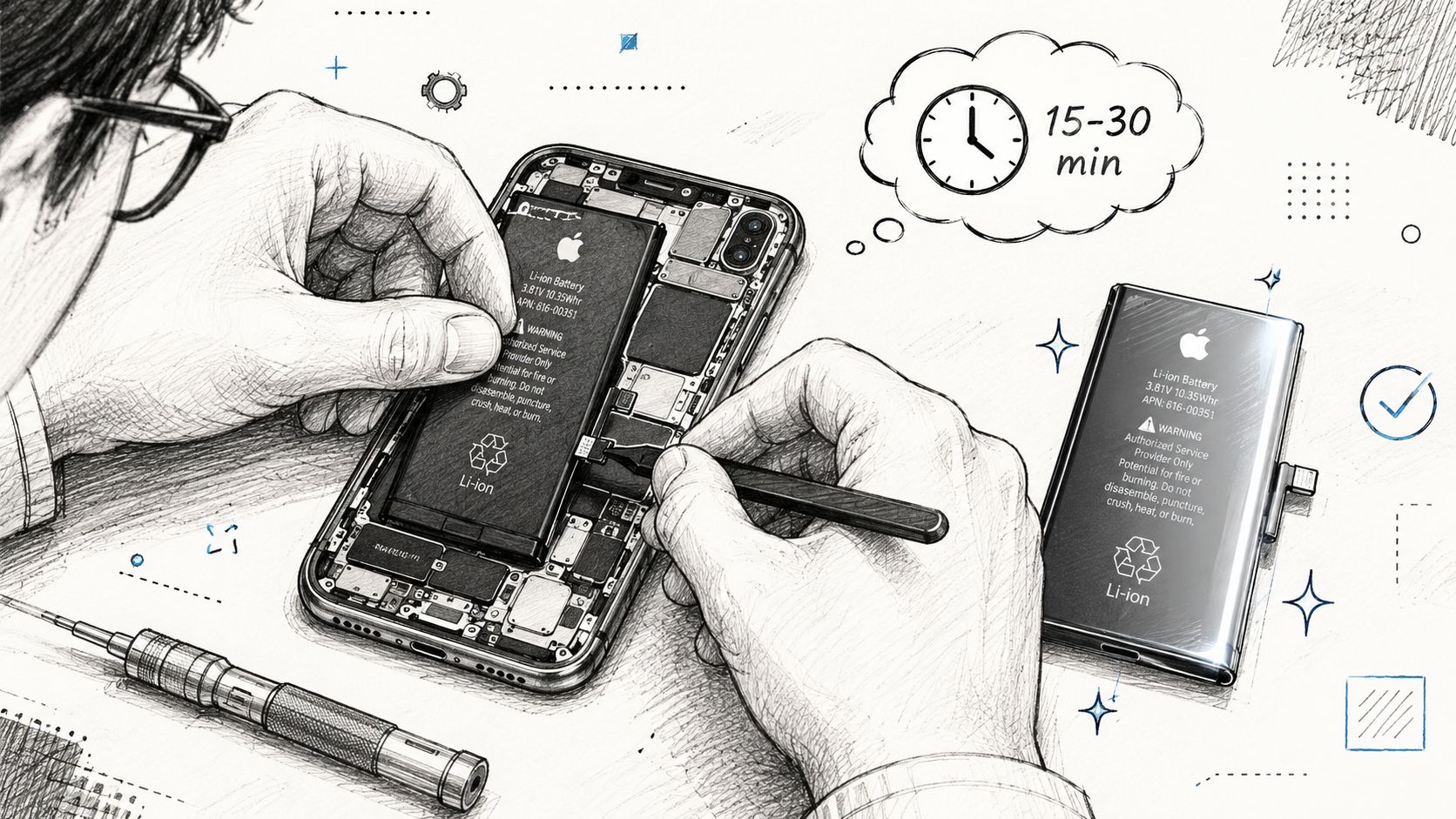
Once the phone is in the technician's hands, the battery change is mostly controlled disassembly and testing. Modern iPhones use a sealed construction, so the technician has to open the device carefully, deal with adhesive, remove the old cell, fit the new one, then confirm that the phone charges and boots correctly.
For a trained technician, that physical swap is usually about 20 to 45 minutes, and Apple-style in-store service is often 30 to 60 minutes when the appointment is booked and the right part is already available timing guidance. That's the part most customers never see, and it's the reason the repair itself can sound simpler than the overall wait.
What takes time inside the bench work
A battery replacement is not just a case of lifting one part out and dropping another in. The technician has to open the device without stressing the display, detach the battery safely, inspect for any signs of swelling or heat damage, and then reassemble everything so the phone still seals and functions properly.
The final check matters. A shop that cares about the result won't just turn the phone on and hand it back. It'll test charging behaviour, touch response, and basic stability before release.
A fast battery swap is only useful if the phone comes back reliable, not just powered on.
That's why the quoted bench time stays short, but the total visit can still run longer if there's a queue, a diagnosis to finish, or a second fault to investigate. The repair is quick. The waiting around is what changes.
Comparing Turnaround Times Workshop vs Mail-In vs Apple
A battery swap only feels fast when the rest of the process stays simple. In practice, the wait is built from separate parts, bench work, booking, postage, diagnostics, and collection, so two people can choose the same repair route and still lose very different amounts of time.
| Service Type | Typical Total Time | Best For |
|---|---|---|
| Workshop drop-in or booked local repair | A few hours, depending on queue and diagnostics | People who need the phone back the same day |
| Mail-in repair | 5 to 7 business days | Customers who can live without the phone for a few days |
| Apple Store appointment | Usually quick bench work, but waiting can stretch when stock or queues are tight | Owners who prefer official service and can book ahead |
A local workshop usually gives the shortest overall turnaround because the phone stays in one place and moves straight through intake, repair, and testing. The actual bench time is only part of the experience, but the customer avoids postal delays and the extra handling that comes with sending a device away. For readers comparing same-day options, iPhone battery replacement while you wait shows how a walk-in or booked workshop slot can cut out a lot of the waiting.
Mail-in repair trades speed for convenience. You do not need to travel, but the phone still has to be packaged, sent out, checked in, repaired, tested, and shipped back, so the total wait usually stretches beyond the bench work itself. That makes mail-in a sensible choice for anyone who can live without the phone for a few days and wants the job handled without a shop visit.
Apple service sits in the middle, but the experience depends heavily on appointment access and parts availability. If the right battery is in stock and the booking goes smoothly, the repair itself can be quick. If the store is busy, or the device needs extra diagnostics before work begins, the wait becomes less predictable. Apple repair support covers the main service routes Apple offers, including store, authorised provider, and mail-in options.
For UK customers, the trade-off is straightforward. Workshop service is strongest on speed, mail-in is easiest to arrange from home, and Apple works well when you can get a clear appointment and the store has what it needs on hand.
A Step-by-Step Look at the Mail-In Process
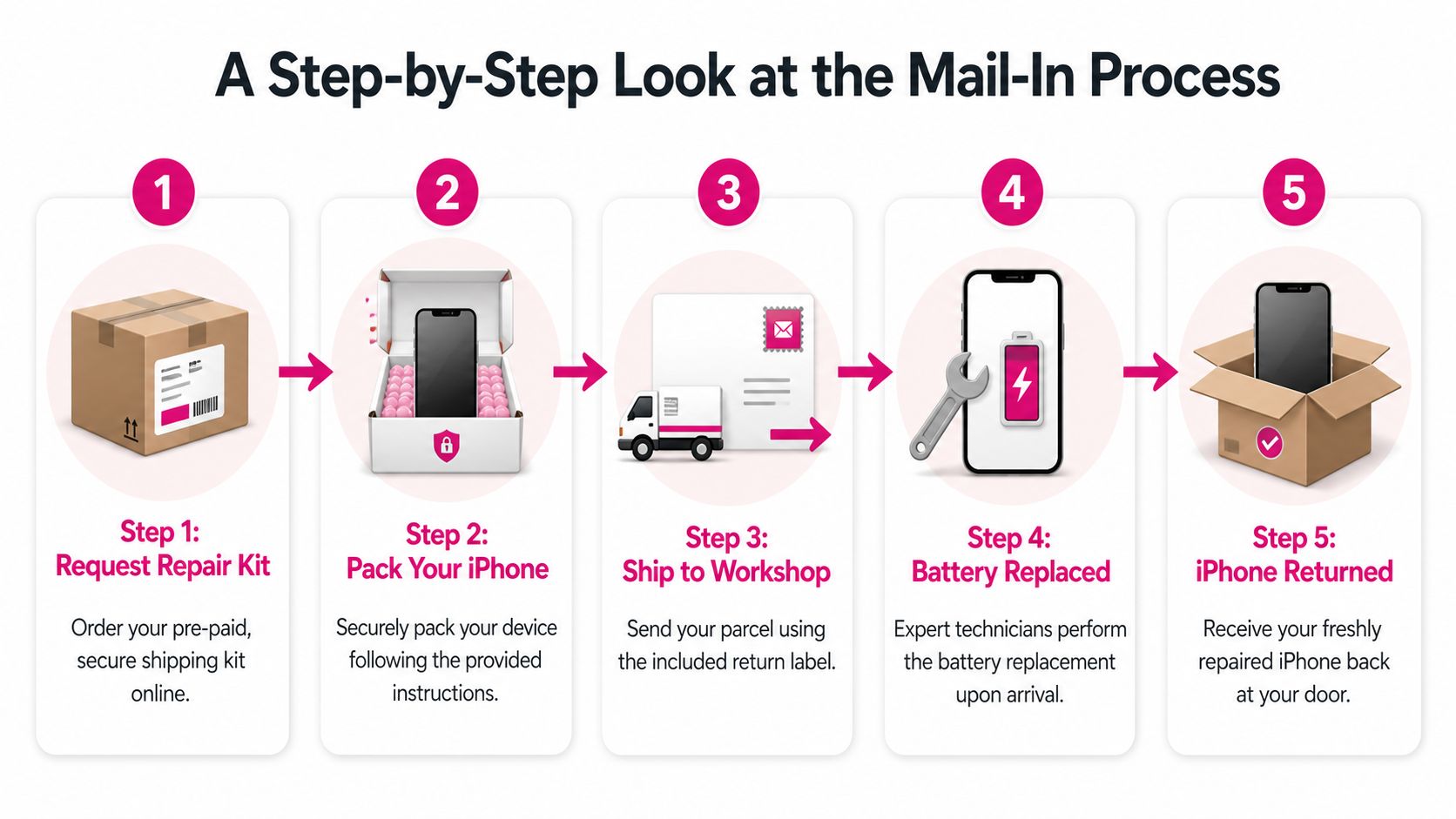
A mail-in repair works best when every stage is clear before the phone leaves your hands. You book the job, pack the device, send it to the workshop, and wait for the battery swap, testing, and return delivery to be completed.
What happens after you book
The first task is getting the iPhone ready for transit. A service such as UK iPhone mail-in battery replacement takes the uncertainty out of postage and return handling, which helps keep the process organised from the start. The delay is rarely caused by the battery work itself. It usually comes from the journey, the intake queue, and the return leg.
How the timeline usually stacks up
- Request the repair kit. You order the shipping materials and follow the instructions.
- Pack your iPhone. The phone is protected for transit so it arrives safely.
- Ship to the workshop. The parcel moves through the postal network.
- Battery replacement and testing. The technician performs the work and checks the result.
- iPhone returned. The repaired device is sent back to your address.
That sequence is why mail-in feels simple but still takes time. The bench work can be quick, yet the total wait includes packing, collection or posting, workshop intake, repair, testing, and the return shipment back to you. Repair My Crack's mail-in service follows that same practical flow, so the customer knows where the phone is at each stage and does not have to guess what happens next.
Mail-in suits people who can plan around the downtime. It is convenient from home, but it is still a postal repair, so the phone is away for the full round trip. If you rely on your iPhone for work, study, or family arrangements, the postal leg is usually the part that matters most.
What Factors Can Delay Your Battery Replacement
Delays usually come from the edges of the process, not the battery swap itself. A technician can finish the repair quickly, but availability, model complexity, and extra checks can all add time before the phone is back in your hands.
Parts and model complexity
Older or less common iPhone models can be slower to service if the correct battery isn't already on the shelf. Some devices also take longer to open and reseal because of adhesive and model-specific disassembly requirements, which is one reason battery work can stretch when the phone is more complex to handle iFixit battery FAQ.
Diagnostics and surprise faults
A battery complaint doesn't always arrive alone. If the technician finds another issue during inspection, such as charging instability or signs of impact damage, the job can stop being a simple swap and become a wider repair decision. That extra diagnosis is often the difference between a quick handover and an extended wait.
Queue pressure and demand spikes
Busy periods are easy to underestimate. Industry reporting showed Apple Store battery-replacement waits rising to 2.7 weeks, up from 2.3 weeks earlier in the month, which is a clear example of how demand and parts availability can overshadow the actual repair time industry wait reporting.
If the repair centre is busy, the battery's replacement time stops being the main variable. The queue becomes the clock.
Logistics beyond the bench
Mail-in customers also need to think about transit. A courier delay, a missed collection, or a slower return leg can easily add friction, even when the workshop has already done the work. That's why a repair that takes under an hour to complete can still feel slow if any of those outside steps slip.
The practical takeaway is simple. Bench time is stable, but the rest of the process isn't. The fewer moving parts in the service route, the easier it is to predict when your iPhone will be usable again.
Getting Your iPhone Battery Replaced Without the Hassle
If speed matters, a local workshop is usually the cleanest answer. If convenience matters more, mail-in service works well as long as you can live without the phone for several days. If you're using Apple support, expect the battery swap itself to be quick, but leave room for booking queues and parts availability.
The best decision is the one that matches your daily dependency on the phone. A commute, work messages, banking apps, and school coordination all change how painful downtime feels, so the “right” turnaround isn't the same for everyone.
Repair My Crack offers UK iPhone battery replacement through both mail-in and appointment-based workshop service, with tested parts and post-repair checks before return. If your battery is draining too fast, getting checked sooner is usually easier than waiting until the phone starts shutting down at the worst moment.
– James Waterston, Device Repair Specialist at Repair My Crack
If your iPhone battery is slowing you down, book a repair with Repair My Crack and choose the turnaround that fits your day, not just your device. The team handles workshop and mail-in battery replacements for UK customers, with clear booking and tracked return options that keep the process straightforward.