
That “oh no” moment usually starts with a slip, a crack, and a split second of silence. I've seen people assume the handset is done for, then discover that a fixed my phone decision was quicker, cheaper, and far less disruptive than replacing the whole device. In the UK, that decision is shaped by repairability rules, spare-parts availability, and the fact that the Competition and Markets Authority has repeatedly backed consumers' right to repair out-of-warranty goods when the work is done properly UK repair policy backdrop. These eight real repair stories show how people chose, what they gave up, and why the repair made sense.
Table of Contents
- 1. iPhone 12 Screen Replacement After Accidental Drop
- 2. Samsung Galaxy A52 Battery Replacement
- 3. Google Pixel 6 Charging Port Repair
- 4. iPhone 13 Back Glass Replacement
- 5. Samsung Galaxy S21 Charging Issue
- 6. iPad Air Screen Replacement
- 7. Google Pixel 5a Camera Repair
- 8. iPhone 11 Battery and Screen Combo Repair
- 8-Case Phone Repair Comparison
- Your Phone, Your Choice What's the Right Move for You?
1. iPhone 12 Screen Replacement After Accidental Drop
A customer sent in an iPhone 12 after a drop onto concrete from roughly two metres. The front glass was cracked, and the bigger problem was the touch sensitivity loss across the lower half of the display, which made typing and swiping unreliable. At that point the repair stops being a cosmetic fix and becomes a practical decision about whether the phone still earns its place in daily use.
The customer weighed screen replacement against trade-in and chose the repair. That fit the way smartphone failures are often concentrated in a replaceable module rather than the whole device, so a screen swap can return the phone to normal use when the rest of the handset is sound technical durability literature. For a working iPhone with display damage only, repair usually protects familiarity, setup, and data continuity better than replacement does.
Practical rule: if the phone still powers on, holds charge, and the damage is isolated to the display, repair often beats the hassle of starting over with a new device.
The mail-in route decided the job. The customer preferred posting the phone instead of visiting a shop, and the repair was completed in 5 working days with free postage both ways and a 12-month warranty. That warranty mattered because it reduced the worry that the phone would come back working but not fully dependable.
For readers comparing repair pages, the screen-repair process is worth understanding before you book, and this guide explains what typically happens during a professional display job: what to expect from a phone screen repair.
The trade-off was straightforward. Keeping the iPhone meant preserving a phone the customer already knew, with no need to rebuild apps, settings, or account access. Replacing it would have meant a bigger reset for a problem confined to the display. In cases like this, repair wins when the handset is otherwise healthy and the owner wants the quickest return to normal use.
A short demo of the repair route sits below.
2. Samsung Galaxy A52 Battery Replacement
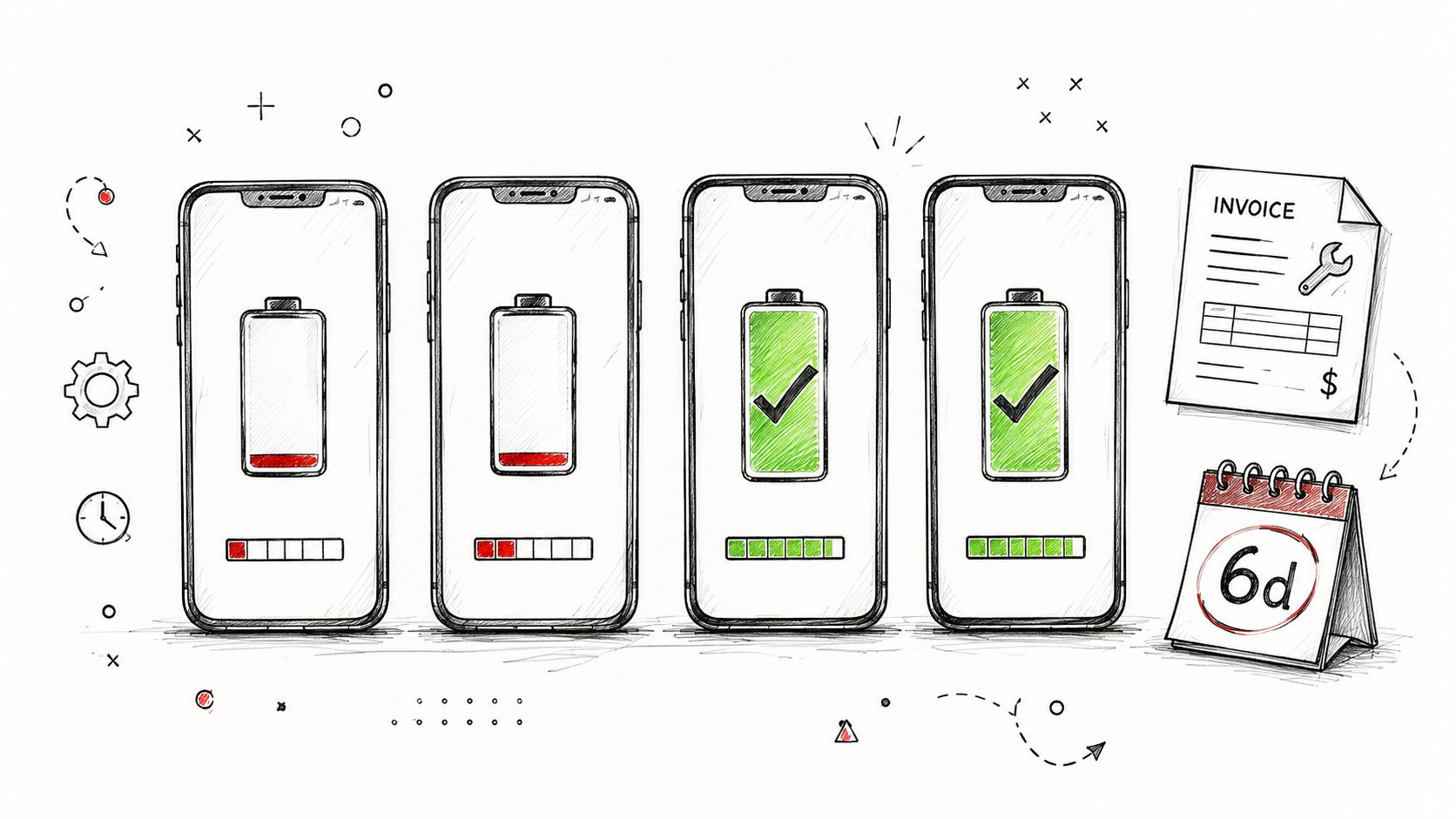
A small business brought in 12 Samsung Galaxy A52 devices, and 4 of them were losing charge quickly after about 18 months of service. In fleet use, that sort of failure shows up unevenly. Some handsets keep going, while the weaker ones become the phones staff avoid because they will not last through a full shift.
The management choice was practical. Replacing only the failing batteries through a single business repair job meant the company could keep the rest of the fleet in service, instead of moving straight into a wider spend on new phones. UK repairability rules also make that approach more realistic than it used to be, because spare parts availability and out-of-warranty repair rights support component-level repair more than a full replacement cycle does UK right-to-repair context.
Why the battery route made sense for a fleet
The firm was not trying to keep old handsets alive at any cost. It wanted steady runtime, fewer interruptions, and less admin than replacing several devices at once. Battery replacement fit that brief because it addressed the exact fault instead of pushing the team into a new procurement round.
The business also needed a repair partner that could work around rollout timing and give a predictable turnaround. A dedicated business repair guide helps here, because fleet decisions need more than a simple yes, the phone can be fixed. The service details and the practical workflow are covered here: business phone repair guide.
For teams, battery repairs are often less about saving one phone and more about keeping every working handset on the same lifecycle.
One useful detail in this case is that the business did not wait for every unit to fail. They acted once the pattern showed up in a few phones, which helped stop the rest of the fleet drifting into the same problem. That is a better commercial decision than replacing devices only after repeated downtime has already started to affect staff.
3. Google Pixel 6 Charging Port Repair
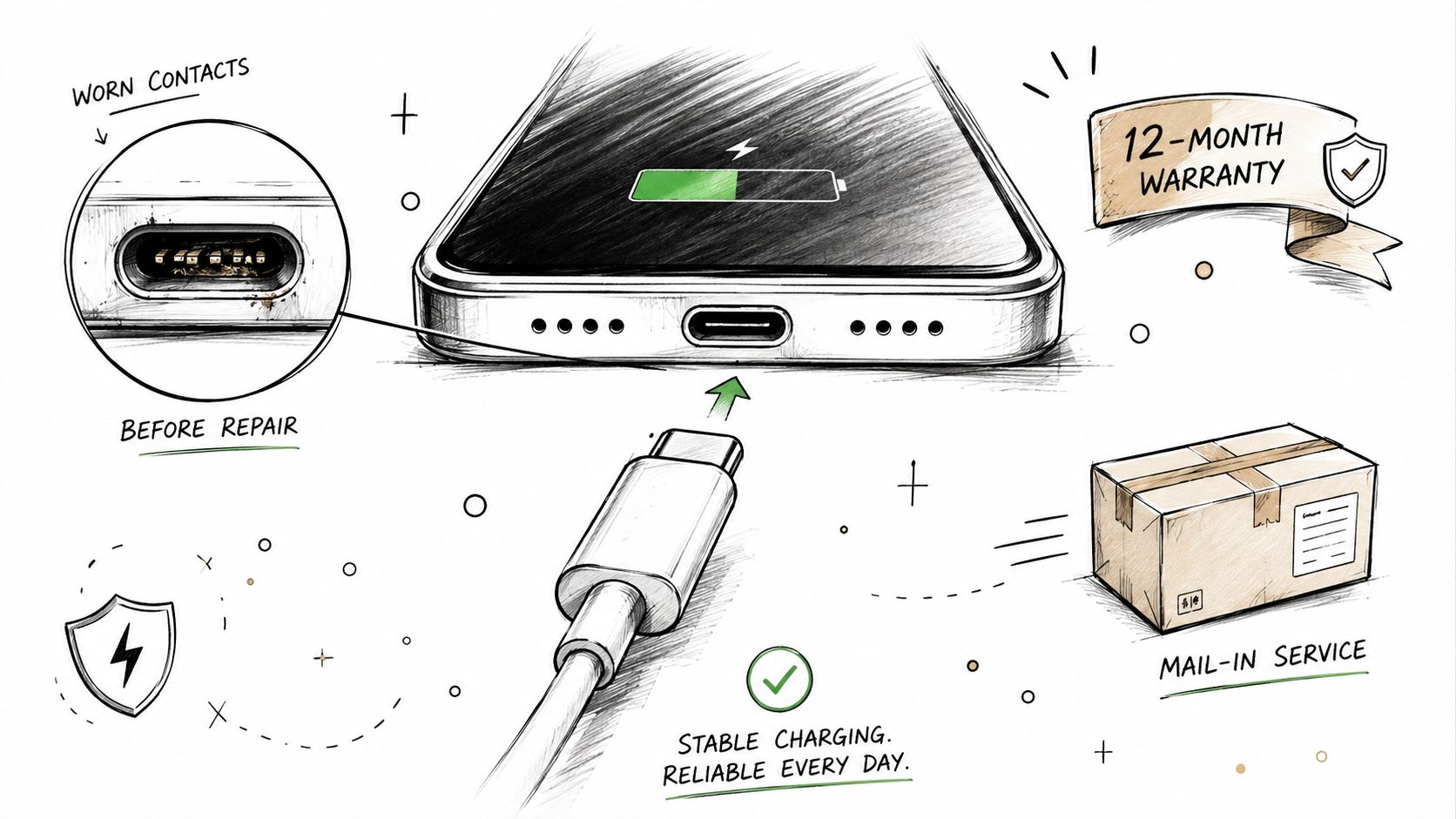
This Google Pixel 6 came in with the familiar intermittent charging fault. The owner had to hold the USB-C cable at just the right angle before the phone would take power, and that sort of problem quickly turns from a nuisance into a daily hassle. People often start by swapping cables and chargers, because that is the cheapest guess, but the fault in this case stayed exactly the same after a few tries.
The customer compared three quotes and chose the mail-in repair because the price matched local options, postage was free, and the 12-month warranty carried more weight than what other providers had offered. That was the decision point. Repair choices are rarely about the lowest headline price alone. When a charging port is the part under strain every day, the customer wants a fix that feels worth trusting, not just one that looks cheap on paper.
For anyone unsure about sending a handset away, the service page on mail-in repairs explains the practical side of the process: is mail-in phone repair safe.
The decision point was the port, not the cable
What made this case stand out was the timing. The phone still worked, but the charging was unstable enough to create worry whenever the battery level dropped. That is where repair economics matter in a very direct way. If a handset can be brought back through a charging-port repair, the owner avoids replacing a device that is otherwise fine, and that matches the case for component-level repair described in the literature smartphone component repair rationale.
The repaired port returned the charging behaviour to normal, which removed the constant cable angling and the uncertainty that came with it. That may sound minor, but it changes how usable the phone feels day to day. A device that charges properly can be relied on again, instead of being treated like something that needs careful handling every time it is plugged in.
4. iPhone 13 Back Glass Replacement
The iPhone 13 in this case had shattered rear glass, while the front display remained intact. That mix often leads people to keep using the phone, because it still looks fine from the front. The problem shows up in daily handling. Sharp edges, exposed damage, and the worry that one more knock could make things worse turn a cosmetic issue into a practical one.
The customer compared an insurance claim with a £75 excess against paying for the repair directly. They chose to pay out of pocket, mainly to avoid the claim process and the possibility of a premium increase. That was a sensible choice for someone who wanted the phone fixed without extra paperwork or a longer wait.
Why direct repair won out
Rear-glass repair shows how a fixed my phone decision often comes down to convenience as much as cost. If the phone's main functions still work, a direct repair removes the damage without the added steps of claims, approvals, and waiting for a decision. The handset gets back into use faster, and the owner stays in control of the repair from start to finish.
The wider UK context supports that choice. Policy changes around telecommunications and security, along with Ecodesign spare-parts requirements, have made repair a more credible option for devices that are otherwise working well. That does not mean every cracked back should be repaired, but it does explain why more people now weigh repair before replacement, as reflected in the UK policy backdrop.
A rear-glass repair is often about reducing risk, not chasing perfection. If the phone is already paid for, keeping it safe to hold can be the smartest win.
In this case, the customer wanted the simplest route back to a clean, safe handset. Direct repair gave them that, without turning a straightforward fault into a long insurance conversation.
5. Samsung Galaxy S21 Charging Issue
The Samsung Galaxy S21 had the look of a charging fault, but the owner had already worked through several chargers and cables without getting a consistent result. That is a common point in the repair process. People start with accessories because they are cheap and quick to test, then the pattern begins to point back to the handset itself.
The customer chose a paid professional diagnostic before agreeing to any parts replacement. That was the sensible call, because the technician traced the fault to a degraded battery cell rather than a basic charging accessory problem. Once the battery was replaced, the phone charged normally again, and the owner stopped spending money on cables and plugs that were never the issue.
A repair shop earns trust through diagnosis. Good diagnosis separates a software glitch, a worn battery, and a true port fault, instead of treating every “won't charge” complaint as the same job. Consumer Reports makes the same general point in practical terms, because some phone problems clear after a restart and memory reset, while others need proper hardware checks Consumer Reports phone troubleshooting.
Troubleshooting first saves money later
A lot of users skip diagnosis because they want a quick answer. The problem is that a quick answer can send them in the wrong direction and cost more in the end. In this case, the customer avoided buying more accessories and reached a more durable fix by paying for the test work first.
The trade-off is straightforward. If a phone is not charging, software checks and charger tests are worth trying, but once those fail, guessing becomes expensive. The battery replacement brought the S21 back to stable charging, which let the owner keep a phone they were already set up with instead of starting over with a replacement handset.
That is a good repair decision. The customer did not stop at asking whether the phone could be fixed. They asked what was broken, and that question changed the result.
6. iPad Air Screen Replacement
A professional services firm used an iPad Air 3rd gen from 2019 as a client-facing device. Once the screen cracked, the tablet became harder to read and the multi-touch response started to fail, which is a real problem when staff use it for presentations, estimates, or intake forms. A business tablet carries a different kind of value from a personal phone, because the way it looks and the way it handles in front of clients both affect the job.
The firm weighed repair, replacement, and a policy change. They chose screen replacement because the device still met their day-to-day needs, and fitting a new screen restored its professional appearance without the disruption of moving everything to a new unit. Replacing the whole tablet would have meant setting up another device, transferring apps, checking compatibility, and dealing with staff downtime.
That choice also fits the wider UK repair environment, where spare parts and repair rights have made component-level fixes a more practical option for many organisations UK repairability environment. For a business that puts tablets in front of clients, that is often easier than treating every crack as a reason to retire the device.
Appearance mattered as much as function
The damage did more than interfere with touch. It changed how the device was perceived. Staff were uneasy handing a cracked, awkward tablet to clients, and that hesitation reduced its day-to-day value before anyone even tapped the screen. Repair addressed both problems, the visual issue and the practical one.
This case also shows why iPad repairs need their own decision process, separate from phone repairs. The business was not trying to save money alone. It was protecting a working process. In commercial settings, that is often the reason repair wins, because downtime, retraining, and staff friction all carry costs even when they never appear on a bill.
7. Google Pixel 5a Camera Repair
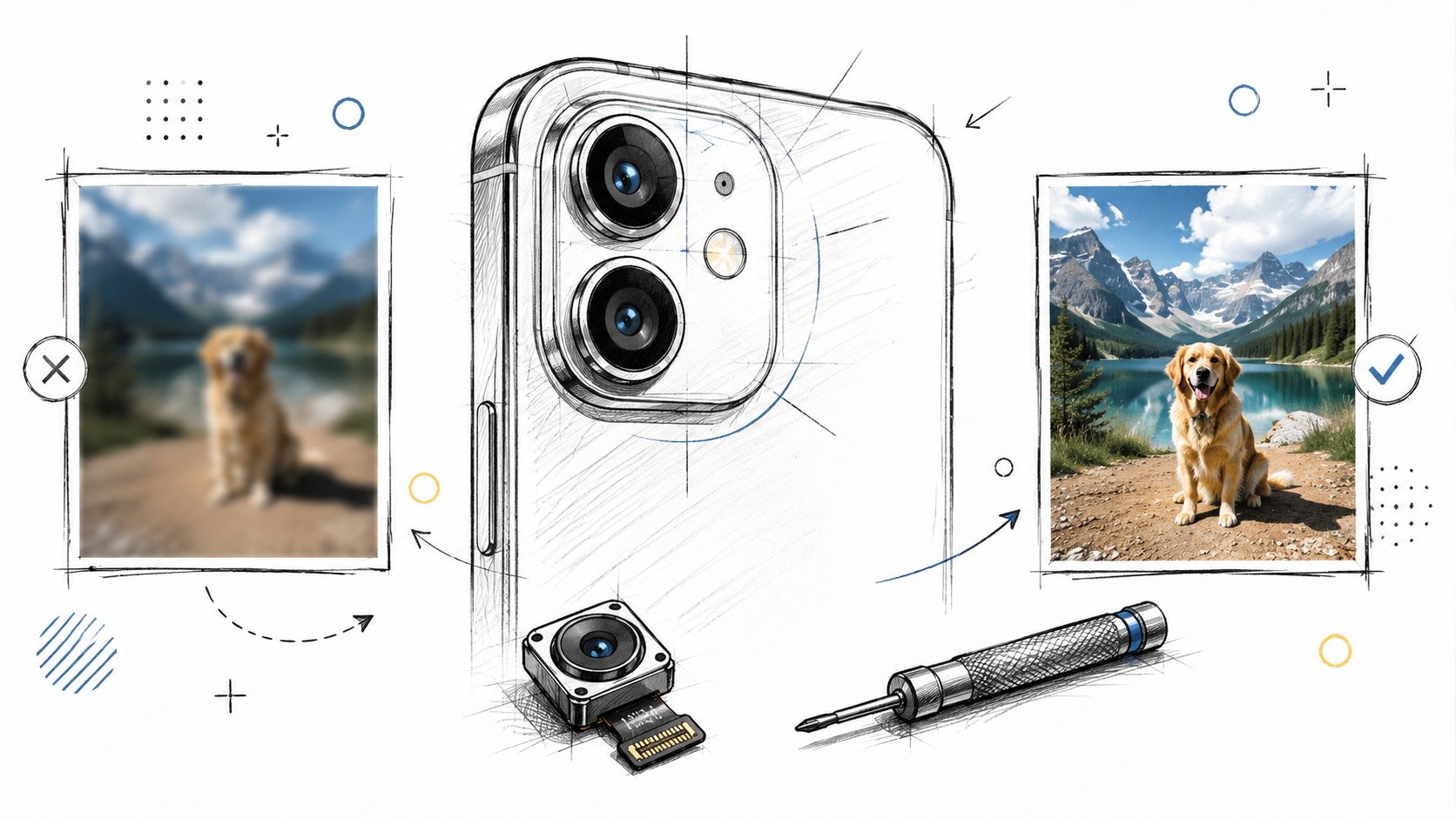
A Google Pixel 5a arrived with autofocus trouble on the primary rear camera, especially beyond 2 metres. In practice, that kind of fault usually shows up in ordinary use first. Photos that should be sharp come out soft, and the problem becomes obvious as soon as the owner tries to shoot people, products, or anything at a distance.
The customer went for a primary camera module replacement instead of keeping a phone with a weakened camera. That is the repair decision point. A handset can still handle calls, messages, and browsing with a faulty camera, but if the camera is one of the features the owner uses every day, replacing the module brings back a big part of the phone's value without forcing a full device change.
The repair was completed in 4 working days, so the phone was not stuck out of use for long. That matters because customers usually accept a short repair window more easily when the payoff is getting the phone back with its main feature working properly again.
The image below shows the practical difference.
The hidden cost of “good enough”
A phone with a broken main camera can still function, but “still works” is not the same as “still worth keeping.” Here, the customer judged the camera to be important enough to repair because the phone needed to take sharp pictures again. The better question was whether they wanted to keep accepting blurred results every time they opened the camera, not whether the device could limp along without autofocus.
That is the kind of trade-off that comes up again and again in repair decisions. If a fault removes one of the features you rely on most, a targeted repair often restores the phone's day-to-day usefulness more efficiently than replacing the whole handset.
8. iPhone 11 Battery and Screen Combo Repair
This iPhone 11 arrived with two separate issues, a weakening battery and hairline screen cracks. That kind of pairing often nudges people toward replacing the whole phone, especially when both faults make the device feel tired at the same time. Here, the customer chose a bundled repair instead, using a multi-repair discount and keeping the phone in one service cycle. That meant less disruption than sending it away twice, and no gap between fixing one fault and still living with the other.
The choice was practical. If only one problem gets fixed, the other one still drags down daily use. A cracked screen and a tired battery are a common combination, and together they make a phone feel older than it really is. Repairing both at once gives the handset a cleaner reset, which is often what matters most when the owner still likes the phone and just wants it to feel dependable again.
Bundling repairs simplifies the decision
The main benefit here was downtime. The phone went through a single 5-working-day cycle, so the owner did not have to manage two separate repair windows, two sets of postage, or two periods of uncertainty. Staged repairs can look manageable on paper, but in practice they stretch the inconvenience out and make the phone feel unavailable for longer than it needs to be.
That decision also fits the economics of keeping a device in service. A screen-and-battery combo repair makes sense when the rest of the phone is still in good working order and the owner has already set up apps, banking, photos, and authentication on it. Replacing the whole handset can bring its own costs and setup work, while a bundled repair keeps the phone they already know and use. For many customers, that is the comparison, not repair cost alone.
The owner in this case wanted a phone that felt dependable again, not just one that looked better. Bundling the repairs delivered that in one pass, which is why it often works well when two faults are already on the bench together. A practical repair should reduce hassle as well as restore function, and this one did both.
8-Case Phone Repair Comparison
| Scenario | Implementation Complexity 🔄 | Resource & Time ⚡ | Expected Outcomes ⭐ / 📊 | Ideal Use Cases 💡 | Key Advantages ⭐ |
|---|---|---|---|---|---|
| iPhone 12 Screen Replacement (mail‑in) | Moderate, standard screen swap; optional Premium LCD | Standard/Premium glass, technician labor, free tracked postage; 5 working days | Restored touch/function; ~46% cost vs new; 12‑month warranty 📊 | Owners seeking cost‑effective life extension (~2 yrs) 💡 | Lower cost than replacement; free postage; 12‑month warranty ⭐ |
| Samsung Galaxy A52 Battery Replacement (fleet) | Moderate, batch battery swaps and consolidated admin | 4 batteries, diagnostics, consolidated invoicing; 6 working days | Restored runtime; deferred £1k+ capex; 68–72% saving vs replacement 📊 | SMB fleet maintenance with multiple affected units 💡 | Cost savings per unit; reduced admin; 12‑month warranty ⭐ |
| Google Pixel 6 Charging Port Repair (mail‑in vs high street) | Low, port module replacement with mail‑in logistics | USB‑C port part, free tracked postage; 4–5 days (actual 4) | Stable charging; price parity with high street; 12‑month warranty 📊 | Users comparing cost/warranty and tolerating short downtime 💡 | Competitive price + longer warranty; fast actual turnaround ⭐ |
| iPhone 13 Back Glass Replacement (out‑of‑pocket) | Low, cosmetic rear glass swap only | Rear glass part, simple procedure; 5 working days | Cosmetic restoration; avoids insurance excess/possible premium increase 📊 | Users preferring to avoid insurance claims for cosmetic damage 💡 | Cost certainty; immediate repair; avoids insurance premium risk ⭐ |
| Samsung Galaxy S21 Charging Issue (diagnostic‑led) | Moderate, paid diagnostic then targeted component swap | Diagnostic (£89, credited) + battery £84; total ≈10+ days due to staged process | Correct root‑cause found; battery replacement resolved issue; prevented wasted parts spend 📊 | Ambiguous charging faults where cause is unclear 💡 | Accurate diagnosis prevents ineffective repairs; warranty on parts ⭐ |
| iPad Air (3rd gen) Screen Replacement (business) | Moderate, tablet screen replacement, preserves configuration | Screen part, tech labour; 6 working days | Restored legibility and professional appearance; ~54% saving vs replacement 📊 | Client‑facing business devices where appearance matters 💡 | Maintains device continuity and branding; faster than migration ⭐ |
| Google Pixel 5a Camera Module Replacement | Low, camera module swap replacement | Camera module part, technician; 4 working days | Restored primary camera performance; ~37% of replacement cost; 12‑month warranty 📊 | Photo‑first users dependent on primary camera functionality 💡 | Recovers core device differentiator (camera); quick, cost‑effective repair ⭐ |
| iPhone 11 Screen + Battery Bundled Repair | Moderate, combined component replacements in one service cycle | Screen + battery parts, multi‑repair discount; 5 working days | Both faults fixed with single downtime; modest bundle saving (£13); 12‑month warranty 📊 | Devices with simultaneous wear that benefit from single downtime 💡 | Convenience (single shipment), small cost saving, comprehensive warranty ⭐ |
Your Phone, Your Choice What's the Right Move for You?
These stories all come back to the same decision, but they arrive there through different routes. Some people repair because the phone is still structurally sound and only one module has failed. Others repair because a business can't afford to replace every handset at once, or because a device's setup, data, and daily routine are worth preserving. The UK repair environment has made those choices more practical, with spare parts, repair rights, and consumer expectations all pointing in the same direction UK repair context.
The smartest repair decisions usually share a few traits. The fault is specific. The rest of the phone still works. The owner values continuity. And the repair delivers more useful life than the replacement path would. That's why a battery swap, a screen replacement, or a charging-port repair can be the right answer even when the handset isn't new. It's not about keeping every old phone alive forever, it's about making a sensible call on the device in front of you.
There's also a practical troubleshooting lesson running through these cases. Some issues are temporary and respond to a restart or a simple software check, as Consumer Reports notes for common glitches and freeze recovery Consumer Reports troubleshooting guide. Others need proper diagnostics before anyone swaps parts. And once the fault is hardware-based, the right repair can save time, reduce waste, and keep a familiar device working the way it should.
If you're deciding between repair and replacement, don't guess from the crack on the outside alone. Look at how the phone behaves, what the fault is costing you in time and frustration, and how much value the device still has in your day-to-day life. If that still leaves you unsure, send it in for a proper quote and let the fault, not the panic, make the decision.
At Repair My Crack, we handle UK mail-in repairs with free tracked Royal Mail postage both ways, plus appointment-only workshop visits in Harlow, Essex. If your phone has a cracked screen, a weak battery, a charging fault, or a damaged camera, visit Repair My Crack to check the repair options and get a clear quote before you decide what to do next.
– James Waterston, Device Repair Specialist at Repair My Crack