
Your iPhone 11 looks fine from across the room, but the moment you use it, the problem shows itself. Maybe the glass has spidered after a drop, maybe the touch panel lags, or maybe the display has gone black and won't come back no matter how many times you charge it. At that point, a cosmetic crack has become a repair decision.
For UK customers, the question usually isn't whether the screen needs attention, it's which repair route makes sense. Apple's official out-of-warranty screen service sits at the premium end, while independent repairs can be much lower because the labour model and parts sourcing are different, with iFixit's comparison showing Apple's iPhone 11 screen replacement at $199 versus $74.99 for a replacement part, a $124 gap and roughly 62% lower on the parts side Apple UK screen replacement support, iPhone Screen Repair pricing comparison. The job is common enough that the market is mature, but the details still matter.
Practical rule: don't book a screen replacement until you've decided whether you're fixing accidental damage, a possible manufacturer fault, or a resale problem that's bigger than the crack itself.
Table of Contents
- When Your iPhone 11 Screen Needs More Than a Quick Fix
- Understanding the iPhone 11 Display Technology
- Comparing Repair Costs and Service Options
- Identifying Manufacturer Faults Versus Accidental Damage
- The Repair My Crack Service Process
- Genuine Parts Warnings and Resale Considerations
- Making the Right Repair Decision for Your Situation
When Your iPhone 11 Screen Needs More Than a Quick Fix
A customer walks in thinking they need “just a screen”. Ten minutes later, the story changes. The glass is cracked, but the bigger problem is that touch drops out in one corner, the display flickers when the phone warms up, or the screen goes black after a short fall and never properly wakes again.
That's the point where an iphone 11 screen replacement becomes a real service job rather than a cosmetic tidy-up. A cracked panel can stay usable for a while, but once touch response becomes unreliable, or the LCD layer starts showing dark patches, you're dealing with lost function as well as broken glass. On the iPhone 11, the display assembly is a single practical unit in the repair workflow, so you're not just changing the outer glass, you're restoring the screen stack that controls image and touch.
What usually tips it over the line
A screen replacement is typically justified when one or more of these show up:
- Touch input stops behaving normally, especially if swipes miss or taps don't register.
- The display blacks out, even though the phone still seems to power on.
- Cracks spread across the viewing area, making daily use awkward or unsafe.
- Liquid intrusion or impact damage starts showing up as discolouration or erratic brightness.
Apple's UK support page makes it clear that screen repairs are handled through Apple-authorised service channels Apple UK screen replacement support, but that doesn't automatically mean the official route is the right one for every owner. If the phone is otherwise healthy, the main decision is whether you want the certainty of Apple handling it, or the lower cost and flexibility of an independent workshop.
The other question is whether the issue is even a broken screen at all. If the phone's been dropped, the answer is usually straightforward. If there's no visible impact and touch starts failing on its own, the diagnosis deserves more care before anyone starts ordering parts.
A clean diagnosis saves money. A rushed screen swap can hide a fault that was never caused by the glass in the first place.
Understanding the iPhone 11 Display Technology
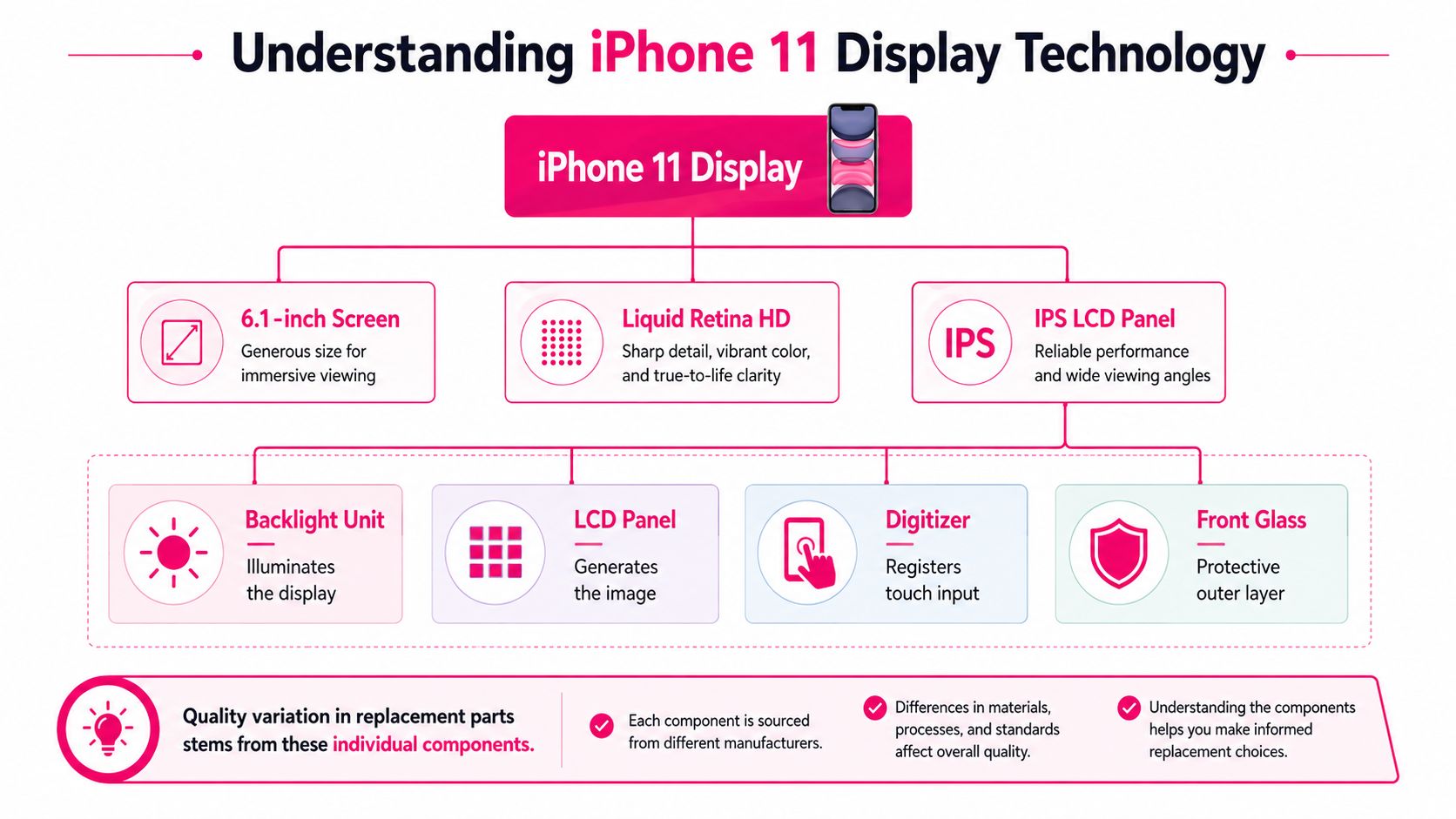
The iPhone 11 uses a 6.1-inch Liquid Retina HD IPS LCD panel with 1792-by-828 resolution at 326 ppi, a 1400:1 contrast ratio, and up to 625 nits typical brightness. Apple lists those figures in its technical specifications, and they matter because a replacement is only right if the phone still looks and feels like an iPhone 11 Apple technical specs. Text should stay crisp, colours should hold their shape, and the screen should remain usable outdoors without constant squinting.
Why the panel type changes the repair outcome
An IPS LCD does not behave like OLED. It relies on the backlight, LCD layer, digitiser, and front glass working as a matched assembly, so a replacement that cuts corners on any one part can change the way the whole phone feels in use. The most common signs are flatter whites, weaker contrast, or touch input that feels slightly less precise at the edges.
For UK customers, brightness is not a side issue. A screen that looks acceptable in a shop can still fall short outside on a bright day, and that becomes obvious very quickly. Pixel density matters too. At 326 ppi, the original display is sharp enough for daily use, so a lower-grade panel with softer text and less defined edges stands out as soon as you compare it with a proper part Apple technical specs.
What a bad replacement usually looks like
Poor screen parts do not always fail in an obvious way. Often the phone still works, but it never quite feels right.
- Colours look flat, especially on white backgrounds and skin tones.
- Brightness changes unevenly, so the screen feels acceptable indoors but struggles in daylight.
- Touch feels delayed or inconsistent, usually because the digitiser quality is poor.
- The fit around the frame is sloppy, which can leave gaps, weaken adhesive, or let dust work its way in later.
That is why screen quality matters more than the cheapest quote. A repair only counts as a proper fix if the phone feels normal after the job, not just switched on.
Comparing Repair Costs and Service Options
A cracked iPhone 11 screen in the UK usually comes down to a choice between Apple-authorised service and independent repair. Apple sits at the higher end because the job is tied to official parts handling, service history integration, and Apple's own repair workflow. Independent providers usually bring the price down by working with different parts supply chains, different labour structures, and shorter turnaround.
The pricing gap is real, and it is not just a small one. Repair charts for the iPhone 11 Series place the total cost in a wide range, and out-of-warranty screen replacement pricing typically starts around $199 SimplyMac repair costs chart. iFixit also shows Apple's iPhone 11 screen cost at $199, with its own Screen Fix Kit at $74.99 iFixit Screen Repair pricing. That difference exists for a clear reason. You are comparing a managed manufacturer repair with parts-plus-labour alternatives, and the outcome is not the same even when the phone powers on normally.
| iPhone 11 Screen Replacement Cost Comparison | Typical Cost Range | Parts Quality | Warranty | Turnaround |
|---|---|---|---|---|
| Apple-authorised service | Higher, premium tier | Genuine Apple parts and authorised process | Apple service terms apply | Usually appointment or mail-in through Apple channels |
| Independent local workshop | Lower to mid-range | Can vary by supplier and grade | Workshop warranty terms vary | Often faster, especially for walk-in jobs |
| Mail-in independent repair | Lower to mid-range | Usually tested aftermarket or OEM-equivalent parts | Usually included by the provider | Depends on postage and queue |
| Parts-only DIY route | Lowest parts cost | Depends entirely on what you buy | No installer warranty | Fast if you have the skill, risky if you don't |
For UK customers, the decision usually starts with the fault itself. If the phone is still within a manufacturer coverage route, that is the first thing to rule out before you pay for a screen swap. If you are comparing local workshop prices, a practical reference point is the iPhone screen repair cost UK guide, which helps set expectations before you decide whether to book locally, send the phone by post, or use Apple's channels.
The headline price only tells part of the story. A good repair also depends on how the display behaves after fitting, whether the adhesive is resealed properly, and what happens if the new panel develops a fault later. Mail-in repair can suit someone who wants a controlled process and does not mind waiting for postage and queue time. A local workshop is often better if you need the phone back quickly and want to see the technician face to face. Official service makes more sense when you want the parts history and warranty path tied to Apple's process, even if that costs more.
Identifying Manufacturer Faults Versus Accidental Damage
A cracked screen is easy to spot. A fault that starts with touch dropouts, ghost taps, or a panel that blanks out on its own needs a slower diagnosis. Apple has already recognised a separate touch issue on certain iPhone 11 units, and affected devices may qualify for a free replacement route rather than a paid screen swap Apple touch issue coverage note. If a customer books the wrong repair, they can end up paying for a problem Apple has already acknowledged.
Signs that point away from a simple drop
If the phone has no obvious crack, no impact mark, and the display starts glitching without a hard knock, I would pause before ordering a new panel. Intermittent touch failure, ghost touches, and black screens with no visible impact damage deserve a closer look. Accidental damage usually leaves clues, a spider crack, a dented corner, or liquid traces under the panel.
A unit that fails on touch alone can still be damaged, but the cause is not always obvious from the outside. In the workshop, I look at the symptom pattern first, then the frame, corners, and screen edges for signs of a fall or pressure point. That approach avoids replacing a screen that was never the root problem.
What to check before paying for repair
Apple says iPhone 11 models and later can show parts and service history in Settings > General > About, including whether the display is marked “Genuine” when Apple parts and processes were used Apple genuine parts and service history information. That makes the About screen worth checking before you assume the problem is purely physical. It also helps if the phone has already had a previous repair, because the warning history can tell you more than the crack in the glass.
If there is no impact damage and the touch issue appears on its own, document the symptoms before you hand the phone over. A clear timeline helps separate a warranty-style fault from an accidental break.
That distinction matters in the UK because repair customers often only want one thing, a working phone. The route to that result changes depending on whether the failure came from a drop, liquid exposure, or a recognised device fault. A good technician should ask about the history before quoting for a panel, and should be willing to say when the repair path is better handled through Apple or through an independent workshop.
The Repair My Crack Service Process
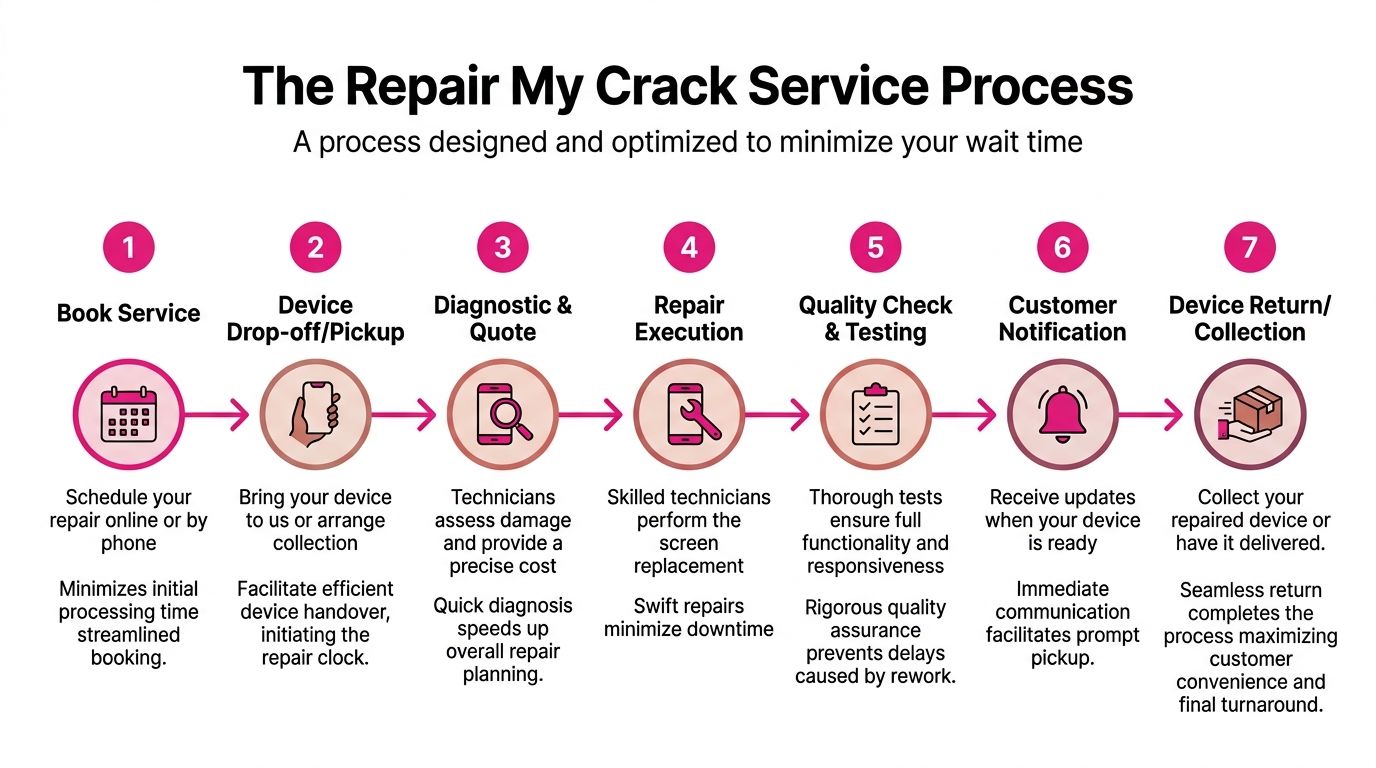
The best repair process is the one that removes uncertainty from the customer's side. Repair My Crack offers UK-wide mail-in repair with free tracked Royal Mail postage both ways and transit insurance up to £750, plus an appointment-based drop-in option at the Harlow, Essex workshop. That matters because screen jobs are only as convenient as the logistics around them, especially if you rely on the phone for work, family, or travel.
What happens from booking to return
The workflow is simple, but each stage protects the phone.
- Book the repair. The customer chooses mail-in or workshop drop-in.
- Device handover. The phone is logged in, packed securely, and checked for visible damage.
- Diagnosis and part selection. The technician matches the correct screen type and confirms the fault.
- Screen replacement. The display connectors are disconnected, the sensor and earpiece flex cable are transferred, and the new panel is fitted.
- Seal and function check. The adhesive seal is replaced where needed and the phone is tested before it leaves the bench.
- Notification. The customer is updated when the device is ready.
- Return or collection. The phone is packaged securely for tracked delivery or picked up in person.
The iDoc replacement workflow shows why those details matter, especially the connector handling, sensor transfer, optional frame sticker seal replacement, and final testing before reassembly iDoc iPhone 11 screen replacement guide. Skip one of those steps and a screen can look fine while still failing in use.
The same repair process underpins the workshop and mail-in offer. On eligible repairs, Repair My Crack includes a 12-month warranty, and that gives customers a practical fallback if the display doesn't settle correctly after fitting. If you want a broader overview of the service model, the company's repair page explains the available options at Repair My Crack phone repairs.
Genuine Parts Warnings and Resale Considerations
A screen replacement affects more than the day the phone comes back. It can change how the iPhone 11 appears to future buyers, trade-in teams, and refurbishers. Apple's parts and service history system can show whether the display is marked Genuine when Apple parts and authorised processes were used. That creates a clear line between official servicing and many third-party repairs.
Why that matters later
If you plan to keep the phone for years, a non-genuine screen warning may only be a minor annoyance. If you expect to sell or trade it in soon, that warning can shape the buyer's view of the device. Refurbishers often check whether the phone reports a genuine display because they want a clear record of what was changed and how the repair was handled.
Independent repair is still a sensible choice in many cases. It just means the trade-off needs to be clear before you book. A less expensive screen can make sense if the phone is staying in daily use and you care more about function than factory service history. If the phone is being prepared for resale, Apple's service history record may carry more weight, especially for buyers who look closely at device history.
A quick way to judge that before booking is to check the original iPhone screen check guidance and compare it with what the repair shop is offering. If you know how the warning system behaves, you can decide whether you want the cleanest possible service record or the better value repair for long-term use.
What to ask before you hand it over
- Will the repair preserve service history transparency?
- Will the replacement screen trigger a warning?
- Is the display part genuine, OEM-equivalent, or aftermarket?
- What does the warranty cover if the warning appears later?
If resale value matters, those questions are worth asking before you approve the job. The decision usually comes down to more than whether the glass lights up again.
Making the Right Repair Decision for Your Situation
The right choice comes down to how you use the phone, how soon you need it back, and what you want the next owner to see. Apple-authorised service makes the most sense when the device is still under warranty, when you plan to trade in soon, or when service history transparency is the priority. Independent repair fits better when cost matters more, when you want the phone back quickly, or when you're keeping the device long enough that resale warnings won't bother you.
Use these questions before you book
- Device usage plans: are you keeping the phone long-term or upgrading soon?
- Budget constraints: does the repair cost sit comfortably below replacement cost?
- Repair quality preference: do you want Apple-style parts history, or are tested aftermarket options acceptable?
- Urgency of repair: do you need the phone back fast enough to favour local turnaround?
If the phone has multiple faults, severe liquid damage, or a repair quote that starts to feel close to replacement value, replacement may be the cleaner choice. A cracked screen on its own is usually worth fixing on an iPhone 11. A cracked screen plus battery problems, charging trouble, and display issues is a different equation.
The cheapest quote is not always the cheapest outcome. A repair only pays off if the screen is fitted properly, tested thoroughly, and covered by a warranty you'd actually trust.
If you're deciding between official service and an independent workshop, look at the whole package, not just the price. For UK customers who want a mail-in option with tracked postage, or a booked drop-in at Harlow, Repair My Crack can handle the screen replacement, test the phone before return, and give you a clear route back to a working iPhone 11 without guessing at the next step.
If your iPhone 11 screen is cracked, blank, or refusing touch, get it checked properly before you pay for a replacement you may not need. Repair My Crack offers UK-wide mail-in and workshop repair options, with tested parts, functional testing, and warranty cover on eligible work. Visit Repair My Crack to book a repair and get your phone back into working order.
– James Waterston, Device Repair Specialist at Repair My Crack